


Have you ever wondered what story is really stitched into our past? The answer lies in the evolution of fashion through history. It’s a powerful force that’s shaped who we are for hundreds of years. Looking at fashion history isn’t just about changing hemlines; it shows us the very soul of society.
Fashion isn’t just decoration. It has impacted everything from ancient times to the modern era. Think of the ’90s grunge fashion or the unforgettable outfits of the 2000s. The narrative of historical fashion is a chronicle of human progress, power, and identity.
So, what is the history behind fashion? What culture impacts fashion? Who started fashion first? This guide explores key historical trends and the vast array of types of fashion styles that emerged. We’ll trace distinct decades of outfits, documenting the shifts in mindset, iconic garments, and overall cultural impact that came with each major fashion trend.
Ancient Greek & Roman Dress
The story of fashion through the ages isn’t complete without first considering what happened in the Ancient Greek and Roman eras. At the time, garments were rectangles of woven fabric, elegantly arranged on the body to create the sense of grace.
Back then, it was all about “the art of the drape.” The focus at the time was on the natural beauty of the human form. So, loose flowing shapes dominated. In Greece, the chiton was a simple tunic, while the himation was a larger cloak draped over it.
In Rome, the iconic toga —a large woolen cloth wrapped around the body —was a powerful symbol of Roman citizenship.
Social status was communicated through the amount, quality, and color of fabric. For example, non-citizens did not wear A Roman citizen’s toga. Also, purple dye (Tyrian purple)was reserved for emperors and senators as a mark of immense wealth.

Portrait of the ancient Roman Toga. Source: Freepik
Middle Ages Fashion Through History
After the fall of Rome, European historical fashion shifted towards practical clothes. Therefore, fashion also changed to meet the demands of a colder climate and a feudal system.
The Layering at this time was for warmth. Sumptuary laws were enacted throughout Europe, regulating clothing, fabrics, and colors. Essentially, different social classes had other rules, making fashion a direct indicator of rank.
Therefore, the wealthy displayed their status through long, voluminous robes made of rich fabrics like velveteen and fur. A great example of these garment types was the houppelande, which was more prominent in the later period.
In contrast, peasants and laborers wore simple, durable tunics and hose that allowed for movement and manual work.
Renaissance Clothing in Fashion through History
The Renaissance era marked a dramatic turning point in historical fashion trends. The focus shifted from the vertical lines of the Middle Ages to a deliberate horizontal structure, emphasizing opulence and human artistry.
Here, the wealthy embraced luxury textiles such as silk, satin, and velvet. Slashing and puffing were also popular techniques for cutting the outer fabric to reveal a contrasting, expensive lining beneath. The entire idea was to display wealth.
Also, silhouettes became broader and geometric. Men wore padded doublets to widen their shoulders and trunk hose. Women’s fashion, in contrast, saw the introduction of the farthingale or bum roll. This was a hoop skirt or set of pads that created a wide, conical shape from the waist down.
Victorian Fashion in the 1890s and the S-Bend Silhouette
The Victorian and Edwardian eras represent the peak of sartorial craftsmanship in Western fashion history. Formality and modesty were the focus, resulting in one of the most extreme silhouettes ever: The S-Bend.
This era of fashion was marked by rigid etiquette and highly structured clothing. Hence, outfits had complex layers. And the iconic S-Bend corset silhouette was achieved through a specific long-line corset style that thrusts the chest forward and the hips backward.
This created a pronounced monobosom effect and an exaggerated S-curve. This shape dominated women’s fashion in the early 20th century.
Beyond the corset, it’s also worth mentioning the Gibson Girl. This idealized woman, illustrated by Charles Dana Gibson, was a fashion icon in the 1890s and early 1900s. She possessed the S-Bend figure and also embodied a new, more athletic and independent spirit. Thus, her S-Bend figure hinted at the changes to come as the evolution of fashion through history.

An illustration of a woman in a late Victorian dress, showcasing the extreme S-Bend silhouette with a forward-projecting bust and hips pushed backward.- Artist unknown. Fashion Plate, 1899. New York: New York Public Library, *MGZFX Fas 1-8. Gift: Lincoln Kirstein. Source: New York Public Library
1900s–1910s, Liberation and War
The first two decades of the 20th century saw the restrictive Victorian silhouette begin to loosen, thanks to radical designers and the unstoppable force of global conflict.
A key highlight is Paul Poiret’s revolution. He declared “war on the corset” and introduced revolutionary high-waisted tunics and dresses inspired by Orientalism and Directoire styles. These designs offered a fluid, column-like shape that liberated women from the S-Bend corset. These clothes also brought a new sense of freedom and exoticism.
Subsequently, World War I (1914-1918) further changed everything about the 90s fashion.
When men were away at war, women entered the workforce in unprecedented numbers. They took roles in factories, farms, and as nurses. These practical, demanding jobs also made the elaborate and restrictive fashion of the previous era completely obsolete. All of this created more demand for simpler, functional, and less decorative clothing. And that pragmatic shift permanently altered the relationship between women and their wardrobes.
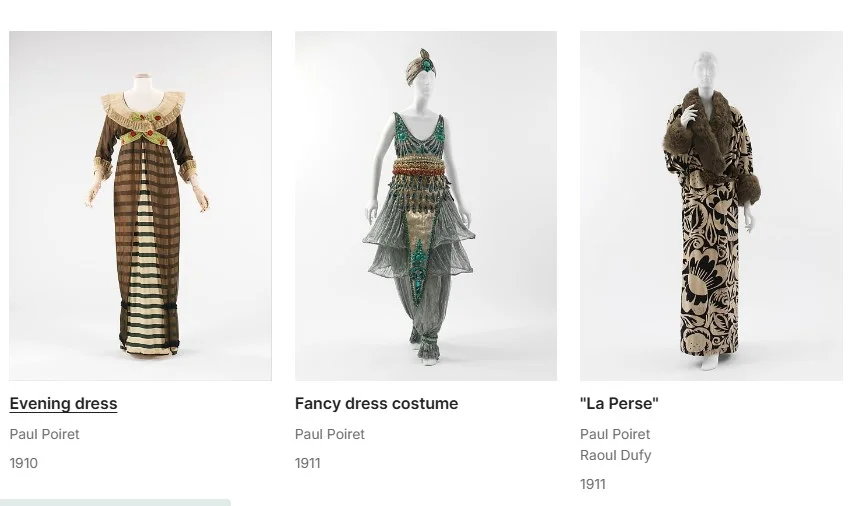
Paul Poiret’s women’s fashion made him “The King of Fashion,” or simply “Le Magnifique,” in Paris, after Suleyman the Magnificent. Source: Metmuseum
1920s Fashion and the Great Gatsby dresses
The 1920s were the beginning of the 20th-century fashion trends. In this century, more women rejected the pre-war S-Bend corset for liberated, androgynous looks that symbolized their new place in the world.
This era birthed the iconic Roaring 20 outfits that continue to captivate to this day, from classic Great Gatsby dresses to the quintessential Gatsby dress seen in modern adaptations.
The silhouette adopted was boyish, straight, and deliberately corsetless. The defining feature was also the dropped waistline, which fell to the hips, creating a long, tubular torso. The look is the foundation for the 1920s-themed party clothes that remain popular for their distinctive shape.
That said, even with freeform clothing taking center stage, iconic 1920s fashion dresses still made an appearance.
A good example is the flapper dress. It was often adorned with fringes and beading to move with the dancer. This centerpiece of any roaring 20s outfit was paired with a close-fitting cloche hat, long strands of pearls, and practical Mary Jane shoes.
Also, the Art Deco fashion influenced these clothes. This was evident in the flapper dresses’ geometric patterns and sleek lines.

Flapper dress of the 1920s fashion through history
Hemlines went above the knee.
One of the most shocking shifts in 1920s fashion was the rise of knee-length hemlines. This was also why the 1920s fashion was known as the garçonne look (meaning ‘boyish’), celebrating the active and independent lifestyle of women.
Beyond the flapper, another iconic highlight was the emergence of the Little Black Dress. In 1926, Coco Chanel debuted her simple, yet revolutionary “Ford” dress in American Vogue. It was a calf-length, straight sheath of black crepe de Chine. Vogue called it “the frock that all of the world would wear.”
Quotes like this cemented the Little Black dress as a timeless staple. It shifted black from mourning to modern sophistication. Don’t forget that the style was basically explored during the post-WWI liberation, alongside the passage of women’s suffrage (the 19th Amendment in the U.S.) and the hedonistic energy of the Jazz Age.

Chanel’s The Little Black Dress
1930s Hollywood Glamour and Fashion through History
The Great Depression and the looming shadow of war tempered the carefree spirit of the 20s. This led to a decade of contrasting elegance and pragmatism. At this time, the world faced economic hardship, so attending the cinema became an escape. Hollywood stars became the new fashion icons, bringing a return of grace and femininity.
The 1930s silhouette was sleek, sensual, and elongated. The boyish look of the 20s was replaced by a bias-cut that clung to the body’s natural curves. It created a fluid, goddess-like effect. Pioneers of this bias-cut gown, like Madeleine Vionnet, mastered the technique by cutting fabrics diagonally to create dresses that drape and move with the wearer. They also featured daring backless designs that are now recognized as coveted 1930s vintage dresses.
At the same time, screen sirens and style icons Katharine Hepburn also championed the women’s pantsuit. Hence, trousers became a thing in both high fashion and everyday wear. It also signaled a new kind of casual confidence for women, offering a modern alternative to the 1930s style.

1930s Hollywood glamour. Source: Classic Critics Corner.
1940s Women’s Fashion and Vintage Dresses
World War II fundamentally reshaped clothing, making fashion a matter of national duty and ingenuity. Most importantly, the 1940s women’s fashion silhouette was practical and military-inspired. This style was defined by square, padded shoulders, a narrow waist, and A-line skirts that just fell at the Knee.
It is also noteworthy that the government mandated the use of utility clothing during WW2. Elaborate details were banned, hemlines rose, and the iconic trench coat history also entered as a practical style staple for both men and women on the home front. This era was defined by “making do and mending.”
That said, some iconic looks still drew celebration. A good example is Dior’s New Look, unveiled by Christian Dior in 1947, just after the world emerged from the trauma of war. He unleashed his “Corolle” line, later dubbed the “New Look” by the press.
It is a direct rebellion against wartime austerity and featured a shockingly luxurious finish. The silhouette was a soft, rounded shoulder, a cinched waist, and a full, calf-length skirt that used a vast amount of fabric.
Hence, Dior created a stark contrast to the years of rationing, thereby making a pivotal point in the historical fashion trend. This move, alongside others, reestablished Paris as the capital of haute couture and signaled the return to Opulence and overt femininity. And it also remains a highly sought-after style for collectors of 40s vintage dresses.

Dior’s New Look post-war fashion. Photographed by Serge Balkin, April 1, 1947. Source: Vogue.
1950s Fashion and the Denim Rebellion
The post-war 1950s also saw a fascinating split in historical fashion trends. On the one hand, the 1950s style of clothing was about hyper-femininity and an affluent look. On the other hand, the growing voice of rebellious youth culture created a wide range of outfits in the 50s.
The first was characterized by the hyper-feminine hourglass, a direct continuation of Dior’s “New Look.” This featured a cinched waist, accented bust, and dramatically full skirts.
Hence, Christian Dior’s New Look evolved into popular styles such as full-skirted cocktail dresses, playful poodle skirts, and tailored men’s suits. There was also the emergence of stiletto heels, which complemented the aesthetic.
Regardless, what did people wear in the 1950s if they weren’t a part of the mainstream?
This was the side of teenage culture. Specifically, denim jeans, which were known before as functional workwear, were co-opted by icons like James Dean and Marlon Brando in films like Rebel Without a Cause.
Hence, these outfits of the 50s became the ultimate symbol of youthful rebellion against suburban conformity, laying the groundwork for rock-and-roll style.
The post-war economic boom and consumerism fueled a culture of idealized domesticity. However, beneath the surface, the seeds of the 1960s counterculture were being sown.

Alt text: Denim jeans through the decades. Source: Futurepossibilities.
1960s Fashion and the Freedom of the Miniskirt
The 1960s exploded with a creative energy that permanently shifted fashion’s center of gravity from the salons of Paris to the streets of London. It was called the “Youthquake.” And it transformed fashion by placing the young ones at the forefront. However, no single silhouette stood out.
Instead, the decade was defined by the contrast between the geometric, clear lines of Mod fashion and the flowing, folk-inspired look of Hippie fashion.
One of the most iconic pieces of this miniskirt history was when the designer Mary Quant championed the short, liberating garment as a symbol of sexual and social freedom. This mini skirt could be paired with a shift dress, go-go boots, and graphic psychedelic prints. Such a look was especially epitomized by the androgynous model, Twiggy.
The influence of bands like The Beatles, who evolved from clean-cut mods to psychedelic hippies, mirrored the decade’s rapid change. And on the social scale, the civil rights movement, the sexual revolution, and the space race all fueled that spirit of rebellion, optimism, and a break from tradition.

Alt text: Chequered miniskirt designed by Mary Quant
1970s: Disco, Punk, and Personal Expression
If the 60s were about youth, the 70s were about radical individualism. This was the decade where every extreme offered a style from its tribe. Silhouettes varied widely from the flowing, natural lines of the bohemian to the sharp, aggressive lines of punk.
The 1970s were the decade that gave rise to some of the most diverse fashion styles in modern history.
The disco era fashion defined nightlife, bringing glittering glamour to the mainstream. Iconic 70s outfits for women included shimmering wrap dresses, wide-legged bell-bottom jeans, and towering platform shoes.
In the 70s, men wore silk shirts unbuttoned to the chest, flared trousers, and tailored leisure suits. The quest for the perfect 70s theme outfits today often leads directly to this glamorous 1970s disco attire.
Simultaneously, daytime style was dominated by romantic 70s style dresses of the Bohemian movement. Think flowy maxi dresses, peasant blouses, maxi skirts, and earthy prints. All these offered a softer, more natural counterpoint to the disco shine.
Even so, in direct opposition to both the disco and bohemian fashion, the punk fashion story emerged. Early on, Vivienne Westwood and Malcolm McLaren defined it. It was a DIY aesthetic of ripped clothing held together by safety pins, bondage gear, and provocative graphics. All these challenged the very notion of fashion through history.
Overall, the Vietnam War, economic uncertainty, and the rise of celebrity culture were the influences that fostered the “me decade” mentality in 1970s fashion for a long time. So, whether you chose sophisticated 70s-style dresses, sharp 70s outfits for women, or punk gear, the ultimate goal was to stand out.
1980s Fashion and the Power Suit
The 1980s further emphasized that individually. But this time, it was about the Unapologetic excess where fashion became a weapon of ambition and a billboard of wealth. The silhouette was bold, exaggerated, and power-driven. It was primarily defined by sharp geometric lines, with the most iconic feature being the shoulder pads of the 80s. This created a broad, triangular shape for both men and women, symbolizing strength and authority.
Some iconic pieces of the time were power-dressing suits, with their strong shoulders and tailored lines. It became the uniform for women entering the corporate world in record numbers. Therefore, it creates a sartorial statement of equality and ambition.
Beyond that, designer denim and logos were also worn conspicuously. And then the fitness craze of the 1980s also brought leg warmers and spandex to mainstream casual wear.
MTV, pop culture, and especially Madonna’s style influenced all of these. Hence, many accessories were all about lace, fishnet, and layering to create a new wave fashion that embraced avant-garde and synthetic materials. The rise of corporate culture, materialism, and new technologies, such as MTV, turned fashion into a global spectacle. This cemented the 80s as a definitive chapter in the archive of iconic decades past.

Source: the 1980s power suit look. Source: The Handbook
1990s era of Grunge Fashion, Minimalism, and Crossroads
In sharp contrast, the 1990s moved away from the excessive glamour of 80s fashion, thereby marking a distinct era in fashion. Instead, two dominant, parallel movements emerged. The first was the raw, anti-fashion “grunge” look, and the second was the sleek, sophisticated wave of minimalism.
1990s fashion was less about what you added and more about what you took away. This theme persists to this day when you consider fashion trends by decade.
The silhouettes of the ’90s-style clothing were also contrasting. For instance, it could go from razor-sharp, streamlined, and simple to slouchy, deconstructed, and intentionally unkempt —the latter known as the “heroin chic” look.
The 90s Grunge fashion movement exploded from the Seattle music scene, after being pioneered by bands like Nirvana. Its uniform consisted of flannel shirts tied around the waist, ripped jeans, band t-shirts, and combat boots. Such a look that championed comfort and authenticity over polish.
On the opposite end, minimalist 90s style was defined by clean lines and luxury fabrics. The slip dress, often worn over a t-shirt, became an iconic evening look. Designers like Calvin Klein and Jil Sander championed this pared-down, sophisticated aesthetic.
Supermodels such as Cindy, Naomi, and Christy, who sold glamorous fantasies, also influenced the 90s fashion. Simultaneously, hip-hop fashion in the 90s became a dominant global force, defined by baggy jeans, oversized sports jerseys, and bold logomania from brands like Tommy Hilfiger and FUBU.
It is interesting to note that this was also the dawn of the internet, heavily influenced by economic optimism and the rise of alternative music, creating a culture that valued authenticity and a new modern simplicity.

90s grunge fashion to 2000s fashion. Source: Freepik
Early 2000s fashion (Y2K)
The turn of the millennium marked the beginning of fashion’s digital era, where the speed of trend cycles exploded and the very definition of a “fashion authority” was democratized.
First came the early 2000s fashion scene (Y2K which was both chaotic and futuristic. This era had extreme dressing, a reaction to the 90s minimalism.
Key 2000s outfit ideas from the time included low-rise jeans paired with crop tops and logo-emblazoned everything. Early 2000s dresses were also the dawn of iconic bandage dresses and asymmetrical hemlines. There was also the love for metallics, rhinestones, and velour tracksuits that defined celebrity style.
The period was a true fusion, creating unique 90s-2000s outfits that blended the tail end of grunge and minimalism with the new flashy Y2k aesthetic. All of that gave rise to maximalist experimentation, from the boho-hippie of Coachella to the edgy “punk-pop” of Avril Lavigne.
In terms of social context, Reality TV and paparazzi culture created a new kind of “celebrity style” that was more influential than high fashion.
The 2010 – 2020s Fashion through History
The 2010 fads and fashions were defined by one thing: the complete takeover of social media, which fundamentally altered how fashion has changed. With the rise of Instagram and later TikTok, trend cycles accelerated from decades to weeks. “Viral trends” became the new normal, and micro-trends emerged and died with breathtaking speed.
In a classic example of fashion’s 20-year cycle, Y2K fashion has seen a massive resurgence in the 2020s, with Gen Z embracing low-rise skirts, butterfly clips, and cargo pants, often sourced from thrift stores. It is a trend fueled entirely by TikTok and a sense of nostalgic irony.
Also, there’s the Athleisure trend, blending sportswear and everyday wear with a focus on sustainability and circular fashion. There’s also fluid gender expression in clothing and the endless revival of vintage aesthetics, often mashed in new ways.
Today, fashion is simultaneously fast (Shein, Temu) and slow (the sustainability movement). It is driven by algorithms, with everyone from high-fashion houses to indie designers creating content specifically for digital platforms. The consumer is now the critic, curator, and creator.
Wrapping Up
Fashion through history curates a journey across time, forming a steady, engaging loop of pushback and change. Picture the stiff S-Bend corset from the 1890s next to the quick, shifting small trends of online eras. People always chase the best way to show who they are. Wars, money surges, and social uprisings have shaped clothing styles.
Now, the big shift in fashion’s past focuses less on clothing form and more on how it feels to wear. World tastes mix fast as web buying takes over. Challenges with sizing, comfort, and cultural fit stand as the last big hurdle. Past patterns highlight the ongoing call for custom touches. That’s precisely why tools like Virtual Try-On matter so much. They fix old worries about fit and doubt using sharp digital tech. This sparks a time of real custom buying with sure steps that link styles across borders.